 World Cup 2026: Culture, consistency & Lamine Yamal: Inside Luis de la Fuente’s Spain
  Did Goldiam International shares really crash 24% in one day? Here’s how the bonus math works
  All the best looks from Paris Haute Couture Week 2026
  After Apple, India’s smartphone manufacturing boom enters new phase with Vivo JV
  World Cup 2026: What’s going on with penalties – is it time to end the ‘stutter’?
  US stocks today: Nasdaq rallies to sharply higher close; chip surge offsets Iran worries
  Wimbledon 2026: How Karolina Muchova and Coco Gauff’s semi-final was decided by rollercoaster tie-break
  OpenAI launches its new family of models with GPT-5.6
  Wimbledon 2026 results: Karolina Muchova beats Coco Gauff in epic tie-break to reach final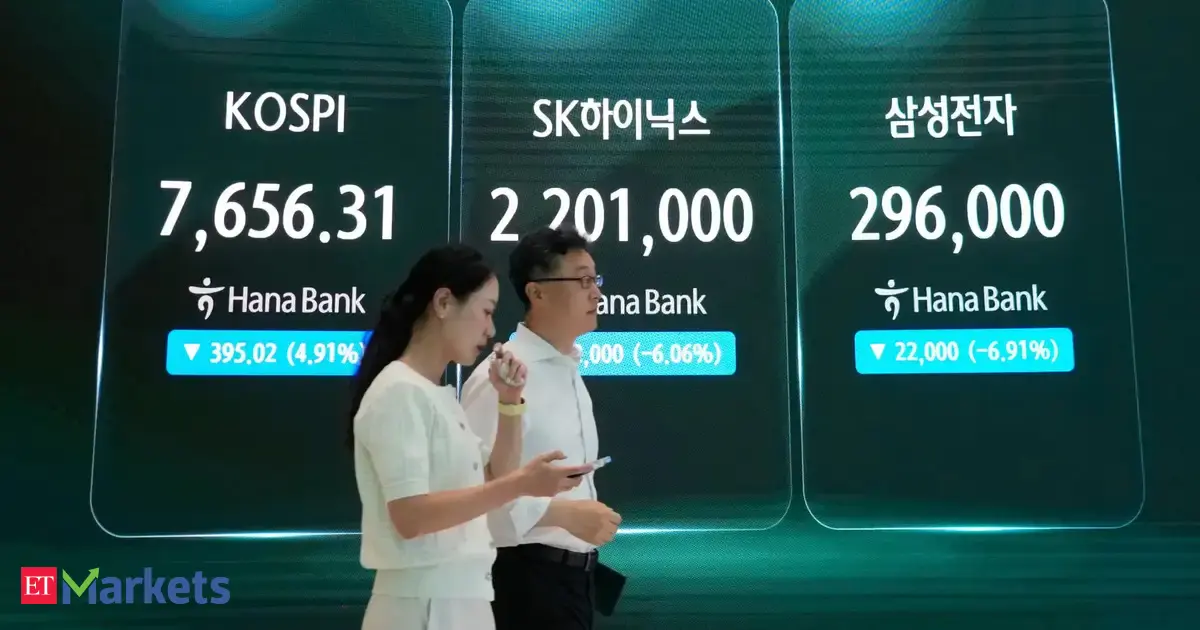
Samsung recovered to trade as much as 1.4% higher after initially falling up to 4.4%, while SK Hynix erased early losses and surged as much as 5.8% after dropping as much as 5% at the open. The early weakness mirrored overnight declines in U.S. semiconductor stocks.
According to Reuters, analysts said investor expectations for the semiconductor sector remain largely intact as the earnings season is still in its early stages. They expect memory chip supply to stay tight through the third quarter, supporting earnings and encouraging bargain buying after Tuesday’s sharp correction.
Investor sentiment also received a boost from optimism surrounding SK Hynix’s planned U.S. listing.
However, analysts cautioned that while memory chip pricing is expected to remain favourable in the near term, price increases during the second half of 2026 are likely to moderate compared with the first half due to a higher base of comparison.

Reuters reported that a Kiwoom Securities analyst lowered his target price for Samsung by around 9% to 390,000 won, citing rising costs for key components such as CPUs and package substrates. Higher component costs are pushing up prices of PCs and smartphones, making customers more cautious about increasing memory purchases, the analyst said. Samsung shares were last trading at 290,000 won.
JPMorgan said memory pricing will remain the primary earnings driver in the second half of the year, according to Reuters. The bank expects supply to continue trailing demand despite increasing customer resistance to higher prices. It also said conventional NAND chip pricing could outperform investor expectations, supported by strong demand from U.S. hyperscale data centre operators.The recovery came after a broad sell-off in U.S. semiconductor stocks overnight. Intel dropped 9.7%, Micron Technology declined 4.7%, and Advanced Micro Devices (AMD) fell 6.5%; the Philadelphia Semiconductor Index lost 4.7% as investors reassessed whether AI-related spending can maintain its current pace, Reuters reported.
The market weakness was triggered by Samsung’s preliminary second-quarter earnings released on Tuesday. Although the company projected a 19-fold jump in quarterly operating profit, the results fell short of elevated investor expectations fuelled by robust demand for AI memory chips.
Samsung’s disappointing market reaction sparked a broader retreat in AI-linked stocks in South Korea before the weakness spread to Wall Street, highlighting growing investor sensitivity to lofty valuations across the semiconductor sector.
(Disclaimer: Recommendations, suggestions, views, and opinions given by experts are their own. These do not represent the views of the Economic Times.)